
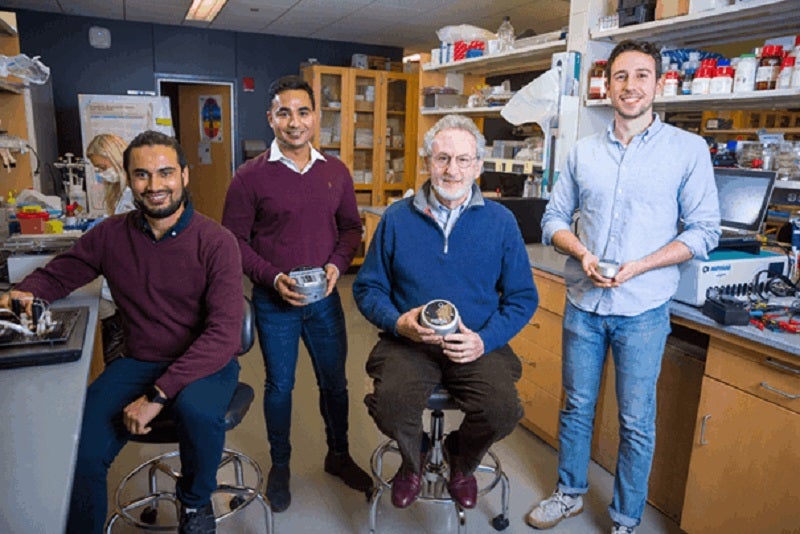
The Wyss Institute for Biologically Inspired Engineering at Harvard University has licensed its eRapid electrochemical biosensor technology to US-based start-up StataDx.
Coordinated by Harvard’s Office of Technology Development (OTD), the licence provides the start-up with exclusive and worldwide access to the technology in the renal diseases, neurological and cardiovascular fields.
Go deeper with GlobalData


Discover B2B Marketing That Performs
Combine business intelligence and editorial excellence to reach engaged professionals across 36 leading media platforms.
The affinity-based, multiplexed, electrochemical sensing platform has been designed for detecting a wide range of biomarkers simultaneously from a single blood drop or complex biological fluids with high sensitivity and selectivity.
eRapid includes a new antifouling nanocomposite coating, which has probes attached that are specific to the target biomarker.
This coating allows the electrochemical electrodes to withstand the attack of biofouling molecules in various biofluids and maintain the sensing capabilities while also reducing any electrochemical background signals.
Wyss Institute researchers Sanjay Sharma Timilsina and Nolan Durr, who were involved in the development of eRapid, will join StataDx’s team.
US Tariffs are shifting - will you react or anticipate?
Don’t let policy changes catch you off guard. Stay proactive with real-time data and expert analysis.
By GlobalDataThe team’s focus will be on developing diagnostic tests for use in near-patient settings, such as physician offices, pharmacies and at-home settings.
StataDX CEO and co-founder Sidhant Jena said: “While there are many at-home tests for viral diseases such as Covid-19 available today, nothing yet exists for patients with complex chronic diseases, such as multiple sclerosis, heart failure or chronic kidney disease, that need periodic measurements of multiple biomarkers.
“The approach enabled by eRapid addresses underlying limitations of electrochemical biosensing in an elegant way, which may overcome the challenge faced by so many promising diagnostic technologies – the successful transfer to manufacturing at scale.
“Our decision to pursue neurology first stems from the significant healthcare burden of an ageing population and the complete absence of a fingerprick blood test for the brain.”
Last May, the Wyss Institute licensed its sample collection swab and high-throughput automation technologies to start-up company Rhinostics.



